Fintech Categories in Kenya’s Startup Ecosystem
5 min read • 8 views
Unknown Author
May 2, 2026
Introduction
At some point, if you’ve ever sent money to a relative, paid for a ride, or taken a quick loan from your phone, you’ve already used fintech. Today, fintech isn’t just a “tech trend” in the background it’s how money actually moves in everyday life. What used to require a bank visit or paperwork now happens instantly, often in just a few taps.
This is a practical look at the key fintech categories already shaping how money is earned, spent, saved, borrowed, and invested, and how these tools are quietly redefining everyday financial behavior.
Payments & Mobile Money
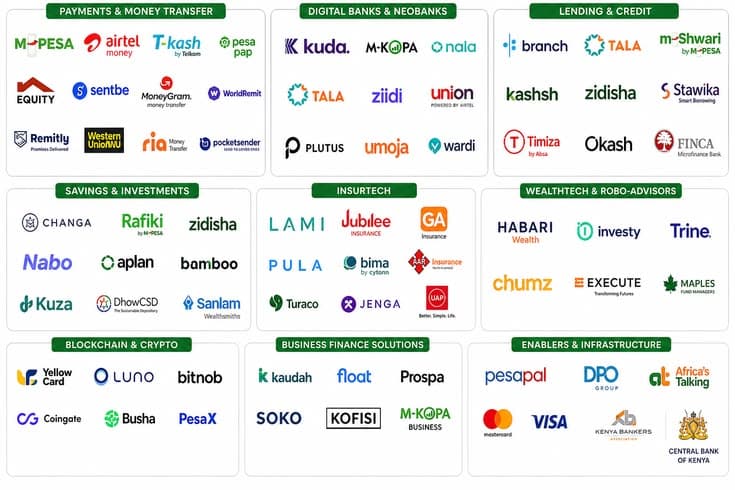
Sending money to a friend, paying a school fee, buying airtime, or clearing your bill at the shop using your phone. Platforms like M‑Pesa, Airtel Money, and similar wallet services sit at the center of the economy. They let people who may never step into a bank still move money safely, quickly, and cheaply.
In kenya money transfer via mobile money provides efficient and secure way of sending money and business transaction.
Digital Lending & Credit
This is the world of apps and USSD codes that give you small loans in minutes, usually straight into your mobile‑money wallet. These platforms use data such as how you use your phone or your mobile‑money history to decide whether to lend you money. Usually there is no paperwork, no long queues, just a few taps and the money arrives.
For the economy, this has two sides. On one hand, it brings credit to people and small businesses who were previously locked out of formal banking. This can fuel petty trade, small projects, and emergencies. On the other hand, concerns about high interest rates, short repayment windows, and aggressive collection practices are real. As the market matures, the balance between access and protection will shape how lending grows.
Savings, Investment & WealthTech
WealthTech platforms use technology to make saving and investing more accessible by lowering entry barriers and automating key financial behaviors. Features such as automatic savings, transaction round-ups, and micro-investing allow users to allocate small amounts into assets like funds or bonds without requiring large capital. These platforms are often integrated with mobile money systems, enabling participation with minimal friction and relatively low starting amounts.
This shift has broader economic implications, as it encourages a transition from short-term consumption toward structured financial planning. As more individuals consistently save and invest, they contribute to a growing pool of capital that can support business expansion and long-term development. At the same time, many platforms embed basic financial education through prompts, simplified insights, and risk explanations making investment decisions more understandable without requiring advanced financial knowledge. A relevant example is Zaiidi by Safaricom.
InsurTech
Insurance technology refers to the use of digital platforms, data, and mobile systems to deliver insurance services more efficiently and at lower cost. It shifts insurance from a complex, paperwork-heavy model to a more flexible and accessible one, where users can purchase policies through mobile apps or USSD. These offerings often include micro-insurance products such as health, accident, or agricultural coverage, with premiums structured in small, manageable amounts and payments integrated into mobile money systems.
By lowering entry barriers, InsurTech expands coverage to individuals and small businesses that were previously excluded or underserved. Farmers can insure crops, traders can protect business assets, and individuals can manage health-related risks without large upfront costs. This broader access to protection enhances financial stability, enabling people to absorb shocks more effectively and participate more confidently in economic activities.
Cryptocurrency & Blockchain: The Emerging Frontier
Cryptocurrency and blockchain represent a developing layer within fintech, centered on decentralized systems for transferring and storing value. These technologies enable users to trade digital assets, receive cross-border payments, and interact with financial systems outside traditional banking structures. Adoption is being driven largely by younger, digitally literate users who are exploring crypto for investment, global earnings, and as an alternative store of value.
At a structural level, this introduces new channels for cross-border income and financial innovation, but also raises concerns around price volatility, fraud risks, and regulatory clarity. The direction this space takes will depend on how effectively oversight frameworks balance innovation with consumer protection and financial stability.
Banking-as-a-Service (BaaS) & APIs
Banking-as-a-Service (BaaS) and APIs form the underlying infrastructure that enables fintech products to function. Rather than building full banking systems, companies integrate with APIs that provide core services such as payments, identity verification (KYC), and account management. This modular approach reduces development complexity and significantly lowers the barrier to entry for new financial products.
From an ecosystem perspective, this shared infrastructure accelerates innovation by allowing companies to focus on user experience and niche solutions instead of rebuilding foundational systems. It creates a more interconnected financial environment where services can scale quickly while maintaining consistency, security, and interoperability.
SME & Business Fintech Solutions
A significant portion of fintech innovation is directed toward businesses, particularly small and medium enterprises (SMEs). These solutions focus on digitizing financial operations, including payments, invoicing, payroll, and access to working capital. Tools such as digital POS systems, invoice financing platforms, and accounting software enable businesses to manage their finances more efficiently.
This segment plays a critical role in economic development, as SMEs form the backbone of employment and trade. By improving financial visibility, enabling access to credit, and streamlining operations, fintech tools enhance business resilience and growth potential. In this context, fintech becomes not just a convenience, but a foundational component of everyday economic activity.